VISTA: Developing New Resources for Inclusive Vocational Education and Training
Published by Giulia D'Agnolo on
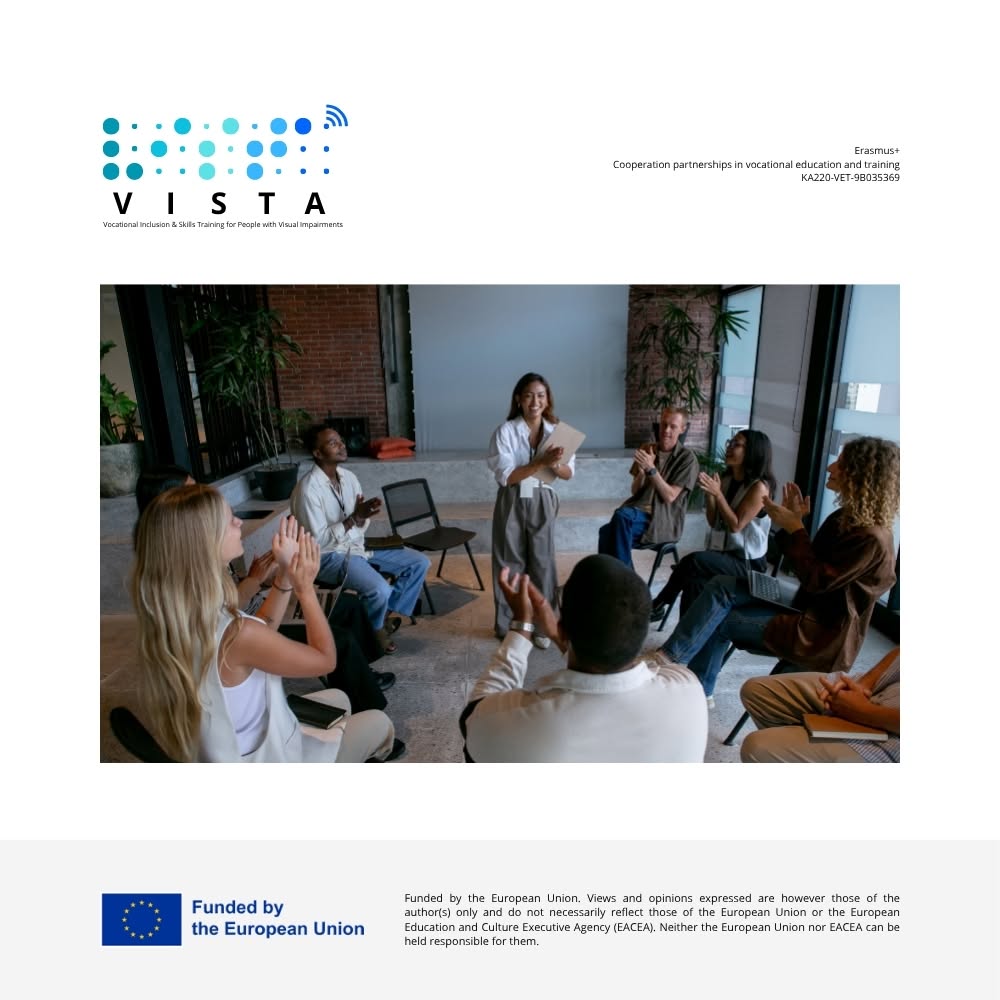
The VISTA project is continuing the development of new resources to make vocational education and training more accessible to young people with visual impairments and better connected to their transition into employment.
Across Belgium, Italy, Greece, Poland and the Czech Republic, the project is addressing some of the barriers that can still limit access to vocational education and employment for blind and partially sighted people, from inaccessible learning materials and limited use of assistive technologies to teaching approaches that do not always respond to individual needs.
At the centre of this work are two resources currently being developed by the VISTA partnership: an Employability Training Curriculum and a Pedagogic Guide for Inclusive VET.
Building skills for the transition to employment
The Employability Training Curriculum is designed to support young people with visual impairments in developing skills that can be directly relevant to education, job seeking and the workplace.
The curriculum covers areas including communication and interpersonal skills, digital literacy and the use of assistive technologies, job readiness and career development, and problem-solving and adaptability.
Rather than focusing only on technical or professional skills, the curriculum looks at some of the broader competences that can help young people navigate the transition from vocational education to employment and participate more independently in professional environments.
Supporting more accessible teaching
Alongside the curriculum, VISTA is developing a Pedagogic Guide for Inclusive VET, aimed at educators and training organisations.
The guide brings together practical approaches for making vocational education more accessible to learners with visual impairments. It covers the use of accessible digital tools and assistive technologies, adapting teaching methods and learning materials, inclusive approaches to assessment and work-based learning, as well as a better understanding of the needs of learners with visual impairments.
Together, the two resources address both sides of the learning process: the skills young people can develop as they prepare for employment, and the approaches educators can use to create more accessible learning environments.
Next step: testing the resources in Cagliari
The next stage will take place from 3 to 5 November 2026 in Cagliari, Italy, where VISTA partners and VET educators will come together to test and review the resources developed so far.
Participants will work with the curriculum and pedagogic guide in international groups, including through practical and micro-teaching activities. Particular attention will be given to accessibility, with materials tested using tools such as Braille displays, text-to-speech, screen enlargement and high-contrast settings.
The feedback collected in Cagliari will then be used to identify what needs to be adjusted or improved as the resources move into their next stage of development.
In the meantime, the VISTA Project Leaflet provides an introduction to the project, its partnership, objectives and the different tools and resources currently under development.
Discover the VISTA Project Leaflet and follow the project for the next updates.